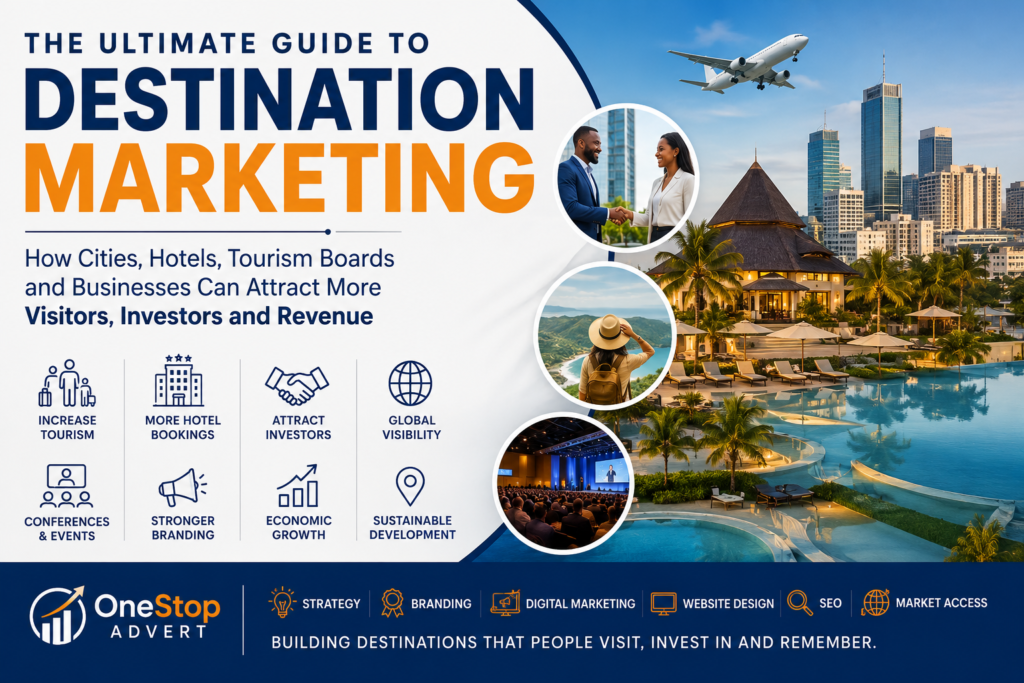
Destination Marketing: Africa’s Untapped Multi-Billion-Dollar Economic Opportunity
Imagine a city where hotels operate at over 80% occupancy throughout the year. Restaurants are filled with local and international visitors. Shortlet apartments receive bookings months in advance. International conferences choose the city as their preferred venue. Airlines continue adding new routes because passenger demand keeps growing. Investors actively seek opportunities, local businesses flourish, and thousands of young people find employment across tourism, hospitality, technology, transportation, entertainment, retail, and professional services.
This is not a dream. It is the outcome of effective destination marketing.
Around the world, destinations that consistently attract visitors, investors, talent, and global attention rarely achieve this by chance. They succeed because they have invested in long-term strategies that shape how the world perceives them, communicate their unique value, and create memorable experiences before, during, and after every visit.
For decades, countries such as Dubai, Singapore, Japan, France, Thailand, Morocco, South Africa and Rwanda have demonstrated that destination marketing is far more than advertising tourist attractions. It is a strategic investment in economic growth, competitiveness, national branding, and sustainable development.
Unfortunately, many destinations across Africa continue to view marketing as an optional promotional activity rather than an essential economic development strategy. As a result, remarkable destinations remain hidden, local businesses struggle to reach international audiences, tourism assets are underutilized, and investment opportunities go unnoticed.
At OneStopAdvert, we believe this can change.
We believe every destination has a story worth telling, a market waiting to discover it, and economic opportunities that can be unlocked through strategic branding, digital marketing, market access, technology, and global partnerships.
This guide explains how destination marketing creates lasting economic value, why it matters now more than ever, and how governments, tourism boards, hotels, shortlet operators, investors, universities, cultural institutions and businesses can work together to build destinations that attract visitors, investment and prosperity.
What is Destination Marketing?
Destination marketing is the strategic process of promoting a city, state, region, country or tourism destination to attract visitors, businesses, investors, events and long-term economic opportunities.
Unlike traditional advertising, destination marketing brings together multiple disciplines, including:
- Branding and positioning
- Tourism promotion
- Digital marketing
- Website development
- Public relations
- Investment promotion
- Business development
- Market research
- Content marketing
- Search engine optimization (SEO)
- Artificial intelligence-powered marketing
- Event promotion
- Stakeholder collaboration
- Customer experience design
The objective extends far beyond increasing visitor numbers.
The goal is to build a destination that people want to visit, invest in, study in, work in, hold conferences in, establish businesses in, and recommend to others.
Successful destination marketing creates a cycle where every positive visitor experience strengthens the destination’s reputation, attracts new audiences, and generates further economic activity.
Destination Marketing Is About Building an Ecosystem
One of the biggest misconceptions is that destination marketing exists only to help hotels or tourism businesses.
In reality, it supports an entire economic ecosystem.
When one international visitor arrives in a destination, they may:
- Purchase an airline ticket
- Pay airport charges
- Stay in a hotel or serviced apartment
- Hire local transportation
- Eat in restaurants
- Shop at local markets
- Visit cultural attractions
- Attend conferences
- Buy locally made products
- Use banking services
- Purchase mobile data
- Hire photographers
- Visit hospitals
- Engage tour operators
- Support entertainers
- Recommend the destination to friends
- Return for future visits
Every visitor creates demand across dozens of industries.
This is why economists often refer to tourism and destination marketing as powerful economic multipliers.
The value of destination marketing is therefore measured not only by visitor arrivals but also by employment, entrepreneurship, foreign investment, tax revenue, export opportunities, and improvements in a destination’s international reputation.
Why Destination Marketing Matters More Than Ever
Today’s world is more connected than at any other time in history.
A traveler in London can book a hotel in Lagos within minutes.
An investor in Tokyo can evaluate opportunities in Abuja without boarding a plane.
A conference organizer in Berlin can compare convention centres across Africa through online research.
Students searching for international education, entrepreneurs looking for new markets, digital nomads seeking vibrant cities, and multinational companies considering regional headquarters all begin their decision-making process online.
The first impression of any destination is no longer created at the airport.
It begins with a Google search.
It continues through websites, social media platforms, online reviews, YouTube videos, AI-powered search results, digital maps, travel blogs, virtual tours and recommendations shared by previous visitors.
Destinations that fail to manage this digital journey risk losing visitors before they even make travel plans.
Conversely, destinations that invest in professional branding, compelling storytelling, search visibility, high-quality websites and seamless online experiences significantly increase their ability to attract visitors and investment.
The Shift from Tourism Marketing to Destination Marketing
For many years, tourism marketing focused almost exclusively on attracting holidaymakers.
Modern destination marketing has evolved into something much broader.
Today’s destinations compete for:
- Leisure tourists
- Business travellers
- International conferences (MICE)
- Foreign direct investment
- Export partnerships
- International students
- Medical tourists
- Sporting events
- Film production
- Technology companies
- Digital entrepreneurs
- Start-up ecosystems
- Creative industries
- Remote workers
- International talent
This broader perspective transforms destination marketing into a strategic driver of national and regional development.
Rather than promoting individual attractions, successful destinations communicate a compelling vision of opportunity, innovation, culture, hospitality and quality of life.
That is why destination marketing has become a priority not only for tourism boards but also for investment promotion agencies, city authorities, chambers of commerce, universities, airports, hospitality businesses and private-sector investors.
Why Africa Has One of the World’s Greatest Destination Marketing Opportunities
Africa possesses extraordinary competitive advantages.
It is home to:
- Rich cultural diversity
- Ancient civilizations
- Vibrant creative industries
- World-famous music
- Exceptional wildlife
- Stunning coastlines
- Mountains
- National parks
- Festivals
- Historical landmarks
- Entrepreneurial populations
- Expanding technology ecosystems
- Young demographics
- Untapped investment opportunities
Yet many of these strengths remain underrepresented in global conversations.
The challenge is rarely the absence of attractions.
More often, it is the absence of coordinated destination branding, digital visibility, strategic storytelling and long-term marketing investment.
This creates an enormous opportunity.
Destinations that invest today in world-class marketing, technology, visitor experience and international partnerships can significantly increase their competitiveness over the coming decade.
For governments, this means stronger economic growth.
For businesses, it means more customers.
For communities, it means more employment.
For investors, it means greater confidence.
For visitors, it means unforgettable experiences.
Destination marketing is therefore not merely a promotional activity—it is an investment in economic transformation.
The Visitor Economy: How One Visitor Creates Prosperity for an Entire Destination
One of the greatest misconceptions about tourism is that it benefits only hotels.
In reality, a visitor does not spend money in just one place. They participate in an entire economic ecosystem. Every journey triggers a chain of transactions that supports businesses, creates jobs, generates tax revenue, and stimulates investment across multiple industries.
This interconnected system is known as the Visitor Economy.
At OneStopAdvert, we define the Visitor Economy as:
The total economic value created when people visit a destination for leisure, business, education, healthcare, investment, events, culture, or other purposes, generating income for businesses, communities, and governments.
Understanding the Visitor Economy changes how governments, businesses, and investors think about destination marketing. Instead of viewing tourism as a standalone sector, they begin to see it as a catalyst for broader economic development.
A Single Visitor’s Economic Journey
Imagine Sarah, an entrepreneur from London, planning her first trip to Nigeria for a business conference in Abuja, followed by a leisure weekend in Ilorin.
Long before she boards a plane, she begins spending money.
She searches online for information about Nigeria, books an international flight, reserves a hotel, arranges airport transfers, purchases travel insurance, exchanges currency, and pays conference registration fees.
After arriving, her spending continues.
She stays in a hotel, uses ride-hailing services, dines at restaurants, buys local crafts, attends cultural events, visits tourist attractions, purchases SIM cards and mobile data, pays entrance fees to attractions, hires photographers, and shops for souvenirs.
Before leaving, she posts photos and videos on social media, writes online reviews, recommends Nigeria to colleagues, and begins planning another visit.
That single journey has generated revenue for dozens of businesses—many of which never interact directly with one another but all benefit from her presence.
Now imagine this multiplied by 100,000 visitors.
Or one million.
That is the power of destination marketing.
The Destination Marketing Multiplier Effect
Destination marketing does not simply increase visitor numbers.
It creates a multiplier effect across the economy.
One successful campaign can increase demand for:
- Hotels and resorts
- Shortlet apartments
- Restaurants and cafés
- Local transportation
- Airlines
- Airports
- Tour operators
- Museums
- National parks
- Cultural festivals
- Entertainment venues
- Shopping malls
- Art galleries
- Local artisans
- Farmers supplying food
- Photographers and videographers
- Event planners
- Security companies
- Cleaning services
- Internet providers
- Banks and payment providers
- Real estate developers
- Construction companies
- Healthcare providers
- Universities
- Professional service firms
Each of these sectors employs people, pays taxes, purchases supplies, and reinvests in the local economy.
The result is a cycle of growth that extends well beyond tourism.
Who Needs Destination Marketing?
One of the biggest mistakes organizations make is assuming destination marketing is only relevant to tourism ministries.
In reality, almost every organization benefits when more people choose to visit, invest in, or engage with a destination.
Hotels and Resorts
Hotels thrive when destinations attract more visitors.
Destination marketing helps hotels achieve:
- Higher occupancy rates
- Longer guest stays
- Increased direct bookings
- Better online visibility
- Stronger international recognition
- Improved revenue throughout the year
Rather than competing solely on price, hotels in well-marketed destinations benefit from a larger overall market.
Shortlet Apartments and Serviced Accommodation
The global rise of serviced apartments and short-term rentals has transformed hospitality.
Modern travelers increasingly seek:
- Flexible accommodation
- Family-friendly spaces
- Remote-work environments
- Affordable long stays
- Authentic local experiences
Destination marketing increases awareness of these options and helps property owners attract guests from domestic and international markets.
Restaurants and Food Businesses
Food is one of the strongest drivers of travel decisions.
Visitors increasingly choose destinations based on culinary experiences.
Destination marketing creates opportunities for:
- Restaurants
- Cafés
- Street food vendors
- Catering businesses
- Local food producers
- Culinary festivals
- Cooking schools
A well-promoted food culture can become one of a destination’s strongest competitive advantages.
Airlines and Airports
Airlines add routes where demand exists.
Airports expand where passenger numbers grow.
Every successful destination marketing campaign strengthens the business case for improved air connectivity, creating additional opportunities for tourism, trade, and investment.
Tour Operators and Experience Providers
Modern travelers seek experiences rather than simply accommodation.
Destination marketing helps promote:
- Guided tours
- Adventure tourism
- Wildlife experiences
- Cultural heritage
- Festivals
- Eco-tourism
- Religious tourism
- Sports tourism
- Educational tours
- Community-based tourism
These experiences encourage visitors to stay longer and spend more.
Universities and Educational Institutions
Education has become a major component of destination marketing.
International students contribute to local economies by paying tuition, renting accommodation, purchasing goods and services, and often inviting visiting family members.
Universities that market both their academic programs and the strengths of their surrounding destination become more competitive globally.
Hospitals and Medical Tourism
Healthcare is increasingly international.
Patients often travel abroad seeking specialized treatment, wellness services, rehabilitation, or elective procedures.
Destinations that combine high-quality healthcare with hospitality, safety, and strong digital visibility can develop thriving medical tourism industries.
Real Estate Developers
A growing destination attracts more than visitors—it attracts residents, investors, and businesses.
As confidence in a destination increases, demand often grows for:
- Residential developments
- Commercial properties
- Mixed-use projects
- Hospitality investments
- Industrial facilities
Destination marketing can therefore contribute to increased property values and new investment opportunities.
Investment Promotion Agencies
Investors rarely commit capital without first developing confidence in a destination.
Strategic destination marketing helps communicate:
- Ease of doing business
- Market opportunities
- Infrastructure
- Skilled workforce
- Government incentives
- Quality of life
By strengthening the destination’s reputation, investment promotion agencies improve their ability to attract domestic and international investment.
State and Local Governments
Destination marketing enables governments to diversify their economies, increase internally generated revenue, create jobs, and improve the quality of life for citizens.
Rather than relying on a single industry, governments can stimulate growth across tourism, agriculture, manufacturing, technology, education, healthcare, culture, and real estate simultaneously.
This makes destination marketing not simply a promotional activity but an important component of economic development policy.
The Cost of Not Investing in Destination Marketing
When destinations fail to market themselves effectively, the consequences extend far beyond tourism.
Potential visitors choose competing destinations.
Hotels experience lower occupancy.
Shortlet operators struggle with inconsistent bookings.
Restaurants lose customers.
Young people miss employment opportunities.
Local artisans sell fewer products.
Conference organizers take events elsewhere.
Investors overlook promising markets.
The destination’s story remains untold.
Meanwhile, competing cities continue strengthening their brands, expanding their visitor economies, and attracting global attention.
In today’s connected world, invisibility is no longer neutral—it is a competitive disadvantage.
Destination Marketing Is an Investment, Not an Expense
One of the most significant mindset shifts for business leaders and policymakers is understanding that destination marketing should not be viewed as a cost.
It is an investment in future economic growth.
Every successful campaign has the potential to generate returns through:
- Increased visitor spending
- Business expansion
- Job creation
- Higher tax revenues
- Foreign direct investment
- Improved international reputation
- Greater entrepreneurial opportunities
Destinations that consistently invest in strategic marketing build long-term competitive advantages that are difficult for others to replicate.
The question is no longer whether destinations can afford to invest in marketing.
The real question is whether they can afford not to.
THE ULTIMATE GUIDE TO DESTINATION MARKETING
The OneStopAdvert DESTINATION Framework™
A Strategic Framework for Building Globally Competitive Destinations
“Great destinations are not discovered by accident. They are designed, branded, promoted, experienced and continuously improved.”
— OneStopAdvert
Why We Developed the DESTINATION Framework™
One of the biggest problems in destination marketing across Africa is that many organizations approach it as a collection of isolated marketing activities.
Some focus only on advertising.
Others only build websites.
Some only organize tourism events.
Others only create social media pages.
While each of these activities has value, they rarely produce transformational results when implemented independently.
Destination marketing is much bigger than marketing.
It is about creating an ecosystem where branding, investment, tourism, technology, infrastructure, partnerships and visitor experiences work together.
After years of supporting organizations with digital marketing, website development, market access, branding and business growth strategies, OneStopAdvert developed the DESTINATION Framework™—a comprehensive model that helps destinations attract visitors, investors, businesses, conferences and long-term economic opportunities.
Rather than asking, “How do we promote our destination?”
We encourage leaders to ask:
“How do we build a destination people genuinely want to visit, invest in, work in, study in and recommend?”
That shift changes everything.
The DESTINATION Framework™
The word DESTINATION represents eleven interconnected pillars that work together to create sustainable destination growth.
D — Destination Research & Intelligence
Every successful destination strategy begins with understanding the market.
Before spending money on advertising, destinations must answer critical questions:
- Who are our ideal visitors?
- Which countries should we target?
- What experiences are travelers looking for?
- What are our strongest competitive advantages?
- How do competing destinations position themselves?
- What are people searching for online?
- Which sectors offer the greatest investment opportunities?
Without research, marketing becomes guesswork.
With research, every campaign becomes more strategic.
At OneStopAdvert, research forms the foundation of every destination marketing strategy.
E — Experience Design
People remember experiences, not advertisements.
A beautiful campaign cannot compensate for a disappointing visitor experience.
Successful destinations intentionally design memorable experiences from the moment someone first discovers the destination online until long after they return home.
Experience design includes:
- Airport arrival
- Signage
- Customer service
- Hospitality
- Transportation
- Safety
- Accessibility
- Digital convenience
- Local interactions
- Attractions
- Accommodation
- Food
- Entertainment
Every positive interaction becomes part of the destination’s reputation.
S — Storytelling & Strategic Branding
Facts inform.
Stories inspire.
The world’s most successful destinations tell compelling stories.
People rarely travel because a destination has buildings.
They travel because they imagine themselves experiencing something meaningful.
Storytelling transforms:
A beach
into
“A place where families reconnect.”
A mountain
into
“An unforgettable adventure.”
A cultural festival
into
“A celebration of identity.”
A city
into
“A place where innovation meets heritage.”
Strong storytelling creates emotional connections that advertising alone cannot achieve.
T — Technology & Digital Transformation
Today’s visitor journey begins online.
If a destination cannot be found digitally, it becomes invisible to many potential visitors.
Technology should support every stage of the visitor experience.
Examples include:
- Destination websites
- Online booking systems
- AI chatbots
- Interactive maps
- Digital payments
- Virtual tours
- Smart tourism platforms
- Visitor analytics
- Mobile applications
- Customer relationship management (CRM)
Technology does not replace hospitality.
It enhances it.
I — International Promotion
Destination marketing should never stop at local audiences.
International visibility creates opportunities for:
- Tourism
- Foreign investment
- Conferences
- Education
- Exports
- Partnerships
This requires:
- Search Engine Optimization (SEO)
- AI Search Optimization
- International public relations
- Travel media
- Influencer campaigns
- Trade exhibitions
- Global partnerships
- Content marketing
- Video marketing
- Multilingual communication
Destinations that consistently communicate internationally remain top-of-mind when opportunities arise.
N — Network Building
No destination succeeds alone.
Governments cannot build thriving destinations without businesses.
Hotels cannot succeed without airlines.
Airlines need airports.
Tour operators need attractions.
Universities need welcoming communities.
Investors need trusted local partners.
Destination marketing therefore depends on collaboration among:
- Government agencies
- Tourism boards
- Hotels
- Airlines
- Chambers of commerce
- Universities
- Investors
- Cultural institutions
- Technology companies
- Creative industries
- Local communities
Strong networks create stronger destinations.
A — Advertising & Awareness
Even the world’s best destination cannot succeed if nobody knows it exists.
Strategic advertising increases awareness through:
- Google Ads
- Social media advertising
- Display advertising
- Travel publications
- Influencer partnerships
- Television
- Outdoor advertising
- Programmatic advertising
- AI-driven campaigns
Advertising should always support long-term brand building rather than short-term visibility alone.
T — Tourism & Trade Partnerships
Destination marketing extends beyond attracting leisure visitors.
It also involves building strategic partnerships with:
- Airlines
- Travel agencies
- Tour operators
- Event organizers
- Export promotion agencies
- Chambers of commerce
- International associations
- Universities
- Development organizations
These partnerships expand market reach while creating new opportunities for tourism, trade and investment.
I — Investment Attraction
Every destination has investment opportunities.
The challenge is making those opportunities visible.
Effective investment promotion communicates:
- Available opportunities
- Market size
- Incentives
- Infrastructure
- Skilled workforce
- Business climate
- Success stories
- Economic potential
Investors rarely invest in places they know little about.
Destination marketing builds familiarity and confidence.
O — Online Visibility
In today’s digital economy, visibility determines opportunity.
If potential visitors cannot find accurate information online, they often choose another destination.
Online visibility requires:
- Search Engine Optimization
- AI Optimization
- Google Business Profiles
- High-quality websites
- Content marketing
- YouTube
- Social media
- Maps
- Online reviews
- Local SEO
- Digital PR
Visibility creates discovery.
Discovery creates enquiries.
Enquiries create bookings.
Bookings create economic growth.
N — Nurturing Relationships
Destination marketing does not end when visitors leave.
The most successful destinations continue building relationships through:
- Email marketing
- Loyalty programmes
- Community engagement
- Visitor feedback
- Social media
- Newsletters
- Personalised recommendations
- Alumni networks
- Business communities
A satisfied visitor often becomes:
- A repeat visitor
- A brand ambassador
- An investor
- A conference organiser
- A student
- A business partner
Long-term relationships generate long-term value.
Why the DESTINATION Framework™ Works
The strength of the framework lies in integration.
Research informs branding.
Branding strengthens storytelling.
Storytelling improves advertising.
Advertising increases visibility.
Visibility attracts visitors.
Visitors generate revenue.
Revenue supports investment.
Investment improves infrastructure.
Infrastructure enhances experiences.
Exceptional experiences create advocates.
Advocates attract even more visitors.
This creates a self-reinforcing cycle of sustainable destination growth.
Rather than treating marketing as a one-time campaign, the DESTINATION Framework™ positions it as a continuous engine for economic development, investment attraction, and global competitiveness.
For governments, this means stronger regional economies.
For businesses, it means more customers.
For communities, it means more opportunities.
For investors, it means greater confidence.
For visitors, it means unforgettable experiences.
And for destinations, it means becoming places that people aspire not only to visit—but also to work, invest, study, build businesses, and call home.
Digital Marketing for Destinations: Turning Global Interest into Visitors, Investors and Revenue
Why Digital Marketing Has Become the Heart of Destination Marketing
Thirty years ago, destination marketing relied heavily on television commercials, travel brochures, newspapers, trade fairs and travel agencies. While these channels still play a role, the way people discover destinations has fundamentally changed.
Today, the world’s first impression of your destination is almost always digital.
Before anyone books a flight, reserves a hotel, invests in real estate, applies to a university, attends a conference or plans a family holiday, they search online.
They ask questions like:
- “Best places to visit in Nigeria”
- “Luxury hotels in Abuja”
- “Shortlet apartments in Ilorin”
- “Medical tourism in Africa”
- “Conference venues in Lagos”
- “Investment opportunities in Nigeria”
- “Best safari destinations in Africa”
- “Study opportunities in West Africa”
- “Top business destinations in Africa”
Increasingly, they are also asking AI assistants such as ChatGPT, Gemini, Claude, Microsoft Copilot and Perplexity.
If your destination cannot answer these questions with authoritative, engaging and trustworthy content, someone else’s destination will.
Digital marketing is no longer a support function. It is the primary gateway through which destinations compete for global attention.
The Modern Digital Destination Journey
Every successful destination should design its digital presence around the visitor’s decision-making journey.
Stage 1: Discovery
Potential visitors first become aware of the destination through search engines, social media, YouTube videos, travel blogs, online news, AI assistants or recommendations from friends and colleagues.
This is where strong storytelling, search engine optimisation (SEO), public relations and content marketing begin to influence perception.
Stage 2: Inspiration
Once people become aware of the destination, they seek inspiration.
They watch videos, browse photo galleries, compare destinations, read travel stories, explore cultural experiences and imagine themselves there.
High-quality visuals, authentic storytelling and compelling destination branding become essential.
Stage 3: Evaluation
Next, visitors compare options.
They evaluate:
- Safety
- Accessibility
- Accommodation
- Transportation
- Attractions
- Reviews
- Weather
- Costs
- Internet connectivity
- Visa requirements
- Local experiences
A destination with clear, accurate and trustworthy information builds confidence.
Stage 4: Booking
At this stage, every unnecessary step increases the risk of losing the visitor.
Professional destination websites should make it easy to:
- Book accommodation
- Reserve tours
- Register for conferences
- Purchase event tickets
- Contact businesses
- Request quotations
- Download visitor guides
- Make secure online payments
Convenience increases conversion.
Stage 5: Experience
Marketing does not stop when the visitor arrives.
Digital maps, mobile apps, QR codes, AI chatbots, event calendars and multilingual information continue to improve the visitor experience throughout the journey.
Stage 6: Advocacy
Satisfied visitors become powerful marketers.
They leave reviews.
They post photographs.
They create videos.
They recommend the destination to family, colleagues and online communities.
In today’s world, every visitor can become a global brand ambassador.
The OneStopAdvert Digital Destination Ecosystem™
At OneStopAdvert, we believe destination marketing works best when every digital channel supports a single strategy.
Rather than treating each platform independently, we recommend building an integrated digital ecosystem.
1. A World-Class Destination Website
Your website is your digital headquarters.
It should inspire, educate and convert visitors into enquiries, bookings and investments.
2. Search Engine Optimisation (SEO)
When people search for destinations, your website should appear prominently for relevant searches.
SEO helps destinations attract visitors continuously rather than relying solely on paid advertising.
3. AI Search Optimisation (AISO)
AI-powered search is transforming how people discover information.
Destinations should publish authoritative, structured and helpful content that AI assistants can confidently reference.
Content should answer real questions, provide practical guidance and demonstrate expertise.
4. Google Business Profile Optimisation
Hotels, attractions, restaurants, museums and tourism businesses should maintain accurate Google Business Profiles with high-quality photographs, reviews, contact information and regular updates.
This improves local visibility and builds trust.
5. Content Marketing
Every destination has thousands of stories waiting to be told.
Examples include:
- Local culture
- Hidden attractions
- Festivals
- Cuisine
- Business opportunities
- Investment success stories
- Entrepreneur profiles
- Travel itineraries
- Educational opportunities
- Conservation initiatives
Consistent storytelling builds long-term authority.
6. Video Marketing
Video is one of the most persuasive forms of destination marketing.
Short-form videos, documentaries, drone footage, interviews and virtual tours help audiences experience a destination before they arrive.
7. Social Media Marketing
Each platform serves a different purpose.
- Instagram showcases visual experiences.
- Facebook builds communities.
- LinkedIn attracts investors and conference organisers.
- YouTube supports in-depth storytelling.
- TikTok reaches younger audiences through authentic content.
- X (formerly Twitter) enables real-time conversations and event promotion.
An integrated strategy ensures every platform contributes to broader destination objectives.
8. Email Marketing
Visitors who subscribe today may become customers months later.
Regular newsletters can promote:
- Upcoming events
- Investment opportunities
- Travel offers
- Cultural festivals
- New attractions
- Business conferences
Email remains one of the highest-return digital marketing channels.
9. Online Reputation Management
Reviews influence travel decisions.
Destinations should actively encourage feedback, respond professionally and continuously improve visitor experiences based on customer insights.
Trust is earned through transparency and responsiveness.
Why Destination Websites Fail
Many destination websites unintentionally discourage visitors because they are designed as information repositories rather than marketing and conversion platforms.
Common problems include:
- Slow loading speed
- Outdated information
- Poor mobile experience
- Low-quality photography
- Broken links
- Complicated navigation
- No booking capability
- Limited accessibility
- Weak storytelling
- Lack of multilingual support
- No clear calls to action
In an increasingly competitive world, a destination website should function as a digital salesperson available twenty-four hours a day.
What Makes a World-Class Destination Website?
A high-performing destination website should combine inspiration with functionality.
Essential features include:
- Beautiful visual storytelling
- Fast loading speed
- Mobile-first responsive design
- Interactive destination maps
- AI-powered visitor assistant
- Hotel and accommodation directory
- Restaurant directory
- Attractions database
- Event calendar
- Online booking integration
- Secure payment systems
- Downloadable visitor guides
- Conference information
- Investment opportunities
- Business directory
- Emergency contact information
- Accessibility information
- Multi-language support
- Search functionality
- CRM integration
- Analytics dashboard
Every feature should reduce friction and encourage visitors to take the next step.
Destination Marketing Is No Longer About Promotion Alone
The most successful destinations understand a simple truth:
People do not travel because they see advertisements.
They travel because they trust what they have discovered.
That trust is built through exceptional digital experiences, authentic storytelling, transparent information and consistent engagement.
Technology has transformed destination marketing from a campaign into an ongoing relationship.
Destinations that embrace this shift will attract not only more visitors but also stronger investment, higher-value partnerships and long-term economic growth.
At OneStopAdvert, we see digital marketing not as an isolated service but as the engine that connects destination branding, tourism promotion, investment attraction and market access into one integrated strategy designed to deliver measurable results.
Frequently Asked Questions (FAQs) About Destination Marketing
1. What is destination marketing?
Destination marketing is the strategic process of promoting a city, state, region, country or tourism destination to attract visitors, investors, businesses, conferences, students, medical tourists, and international events. It combines branding, digital marketing, public relations, website development, content marketing, investment promotion, and visitor experience management to increase economic growth.
2. Why is destination marketing important?
Destination marketing helps destinations attract more visitors, generate business opportunities, increase hotel occupancy, support local businesses, create employment, attract foreign investment, improve international visibility, and strengthen economic development.
3. What is the difference between destination marketing and tourism marketing?
Tourism marketing focuses primarily on attracting leisure travelers.
Destination marketing is broader. It promotes an entire destination to attract:
- Tourists
- Investors
- Businesses
- Conferences (MICE)
- International students
- Medical tourists
- Digital nomads
- Sporting events
- Film productions
- Export opportunities
Destination marketing supports the overall visitor economy.
4. Who needs destination marketing services?
Destination marketing benefits many organizations, including:
- Hotels
- Resorts
- Shortlet apartment owners
- Tourism boards
- State governments
- Local governments
- Cities
- Airlines
- Airports
- Restaurants
- Universities
- Hospitals
- Museums
- National parks
- Shopping malls
- Real estate developers
- Event organizers
- Conference centres
- Chambers of commerce
- Investment promotion agencies
- Export promotion organizations
5. How does destination marketing increase hotel bookings?
Destination marketing increases awareness of a destination, attracts more visitors, improves search visibility, strengthens destination branding, promotes local attractions, and encourages travelers to book accommodation, tours, restaurants, and other services.
Higher visitor numbers generally create more booking opportunities for hotels and serviced apartments.
6. How can destination marketing help shortlet apartment owners?
Destination marketing helps shortlet owners by:
- Increasing online visibility
- Improving website traffic
- Attracting international travelers
- Increasing direct bookings
- Reducing dependence on a single booking platform
- Building brand credibility
- Showcasing unique experiences
- Generating repeat visitors
7. Can destination marketing attract foreign investors?
Yes.
Investors are more likely to consider destinations they understand and trust.
A strong destination marketing strategy communicates investment opportunities, infrastructure, market potential, skilled talent, government incentives, business success stories, and quality of life.
8. What industries benefit from destination marketing?
Destination marketing supports:
- Hospitality
- Tourism
- Aviation
- Transportation
- Restaurants
- Retail
- Entertainment
- Agriculture
- Construction
- Healthcare
- Education
- Technology
- Real estate
- Banking
- Telecommunications
- Creative industries
Every visitor supports multiple sectors of the economy.
9. What are the main components of destination marketing?
An effective destination marketing strategy typically includes:
- Destination branding
- Market research
- Digital marketing
- Search engine optimization (SEO)
- AI search optimization
- Website development
- Public relations
- Social media marketing
- Video marketing
- Photography
- Email marketing
- Online reputation management
- Investment promotion
- Partnership development
- Visitor experience management
10. What makes a successful destination marketing campaign?
Successful campaigns usually combine:
- Strong branding
- Authentic storytelling
- Professional photography
- High-quality videos
- Modern websites
- Search engine optimization
- Social media engagement
- Public relations
- Influencer partnerships
- Data-driven decision making
- Consistent messaging
- Excellent visitor experiences
11. Why do some destinations struggle to attract visitors?
Common reasons include:
- Weak branding
- Poor online visibility
- Outdated websites
- Limited digital marketing
- Poor visitor experience
- Lack of investment promotion
- Weak stakeholder collaboration
- Inconsistent messaging
- Limited international exposure
Many destinations have excellent attractions but lack effective marketing strategies.
12. How important is SEO for destination marketing?
SEO is essential because most visitors begin planning online.
Ranking highly for searches such as:
- Best places to visit in Nigeria
- Hotels in Abuja
- Luxury resorts in Africa
- Conference venues in Lagos
- Shortlet apartments in Ilorin
helps destinations attract qualified visitors consistently without relying solely on paid advertising.
13. How does AI affect destination marketing?
Artificial intelligence helps destinations:
- Personalize visitor experiences
- Improve customer support with AI chatbots
- Analyze visitor behavior
- Generate multilingual content
- Recommend travel itineraries
- Improve marketing performance
- Enhance search visibility through AI-friendly content
AI is becoming an important component of modern destination marketing.
14. Why does a destination need a professional website?
A destination website serves as its digital headquarters.
It should:
- Inspire visitors
- Provide accurate information
- Support online bookings
- Showcase attractions
- Promote events
- Present investment opportunities
- Generate enquiries
- Convert visitors into customers
An outdated website can reduce credibility and lead to missed opportunities.
15. How does social media support destination marketing?
Social media enables destinations to:
- Reach global audiences
- Share authentic experiences
- Build communities
- Promote events
- Showcase culture
- Highlight local businesses
- Engage travelers
- Encourage user-generated content
Consistent engagement helps strengthen destination awareness.
16. What role does branding play in destination marketing?
Branding shapes how people perceive a destination.
A strong destination brand communicates:
- Identity
- Values
- Experiences
- Safety
- Hospitality
- Innovation
- Investment potential
Effective branding helps destinations stand out in a competitive global marketplace.
17. What is the visitor economy?
The visitor economy refers to the total economic activity generated when people visit a destination.
Visitors spend money on accommodation, transportation, restaurants, shopping, entertainment, conferences, healthcare, education, and local experiences, supporting businesses and creating employment across many industries.
18. How can governments use destination marketing?
Governments can use destination marketing to:
- Increase tourism
- Attract investment
- Create jobs
- Promote exports
- Encourage entrepreneurship
- Improve city branding
- Increase tax revenue
- Support local businesses
- Strengthen international competitiveness
Destination marketing is an important economic development strategy.
19. Why should destinations invest in digital marketing?
Digital marketing enables destinations to reach potential visitors where travel planning begins—online.
Professional digital marketing improves:
- Search visibility
- Website traffic
- Visitor engagement
- Brand awareness
- Online enquiries
- Booking conversions
- International exposure
20. Why choose OneStopAdvert for destination marketing?
At OneStopAdvert, we combine destination branding, market access, digital marketing, website development, AI-powered marketing, SEO, investment promotion, content strategy, public relations, and international business expertise to help destinations attract visitors, investors, businesses, conferences, and long-term economic opportunities.
Rather than delivering isolated marketing campaigns, we work with clients to build sustainable destination ecosystems that create measurable economic impact.
Whether you represent a hotel, tourism board, state government, investment promotion agency, university, conference centre, airport, or private business, our goal is to help your destination become more visible, more competitive, and more attractive to local and international audiences.
Ready to Position Your Destination for Global Success?
Every destination has a unique story. The challenge is making sure the right people hear it.
If your organization is looking to increase visitor numbers, attract investors, improve occupancy rates, strengthen its brand, or create long-term economic value, OneStopAdvert is ready to help.
Contact OneStopAdvert today to discuss your destination marketing strategy, digital transformation, website development, branding, SEO, AI search optimization, and international market access initiatives.
Together, let’s build destinations that people don’t just visit—they invest in, return to, and recommend.
The Future Belongs to Destinations That Choose to Be Seen
Every destination has a story.
Every city has hidden opportunities.
Every community has unique experiences.
Every hotel has guests waiting to discover it.
Every shortlet apartment has travelers searching for a place to stay.
Every university has students looking for the right learning environment.
Every investor is searching for the next opportunity.
Every conference organizer is looking for the next great venue.
The question is not whether your destination has value.
The real question is:
Does the world know about it?
In today’s connected economy, destinations do not compete only with neighboring cities or countries.
They compete with every destination that is visible, memorable, and trusted online.
Visibility creates awareness.
Awareness creates interest.
Interest creates enquiries.
Enquiries create visitors.
Visitors create investment.
Investment creates jobs.
Jobs create prosperity.
That is the true power of destination marketing.
At OneStopAdvert, we believe destination marketing is about more than increasing visitor numbers. It is about helping destinations unlock their economic potential, strengthen their reputation, attract meaningful investment, and create opportunities that improve lives.
Whether you represent a government agency, tourism board, hotel, shortlet business, university, airport, conference centre, real estate developer, healthcare provider, cultural institution, or growing business, a well-executed destination marketing strategy can help you reach new audiences and achieve measurable results.
Let’s Start a Conversation
We’d love to hear your perspective.
What do you think is the biggest challenge preventing your city, state, business, or destination from attracting more visitors, investors, or international recognition?
Is it:
- Limited marketing?
- Poor digital visibility?
- An outdated website?
- Weak destination branding?
- Funding constraints?
- Infrastructure?
- Policy?
- Something else entirely?
Share your thoughts in the comments below.
Your insights may help another organization facing the same challenge, and they will help us shape future articles, research, and practical resources for destinations across Africa and beyond.
Let’s Build the Next Great Destination Together
If you’re ready to transform your destination into a place that attracts visitors, investment, conferences, talent, and long-term economic growth, we’d be delighted to discuss your goals.
OneStopAdvert works with organizations to deliver integrated destination marketing solutions, including:
- Destination branding and positioning
- Tourism and investment marketing strategies
- Professional website design and digital experiences
- Search engine optimization (SEO)
- AI-ready content strategies
- Social media and content marketing
- Public relations and storytelling
- Photography, video production, and virtual tours
- Market research and business intelligence
- Digital advertising campaigns
- Visitor engagement strategies
- Market access and international promotion
Every destination is different, so every strategy should be tailored to its unique strengths, audiences, and ambitions.
If you’d like to explore what’s possible for your destination, we’d welcome the opportunity to learn about your vision and discuss how we can help.
If You Found This Guide Valuable…
Please consider helping others discover it.
- Share it with a hotel owner, tourism operator, or shortlet host.
- Send it to your state tourism board or investment promotion agency.
- Forward it to a colleague working in hospitality, real estate, education, or economic development.
- Discuss it with your local chamber of commerce or business association.
A single conversation can inspire a project.
A single project can transform a destination.
And a transformed destination can create opportunities for generations.
Thank you for reading.
The future belongs to destinations that choose to be seen.
OneStopAdvert — Helping Destinations Grow, Compete, and Prosper Through Destination Marketing, Digital Innovation, and Global Market Access.
Book a Free Destination Marketing Consultation. Contact us via support@onestopadvert.com .